



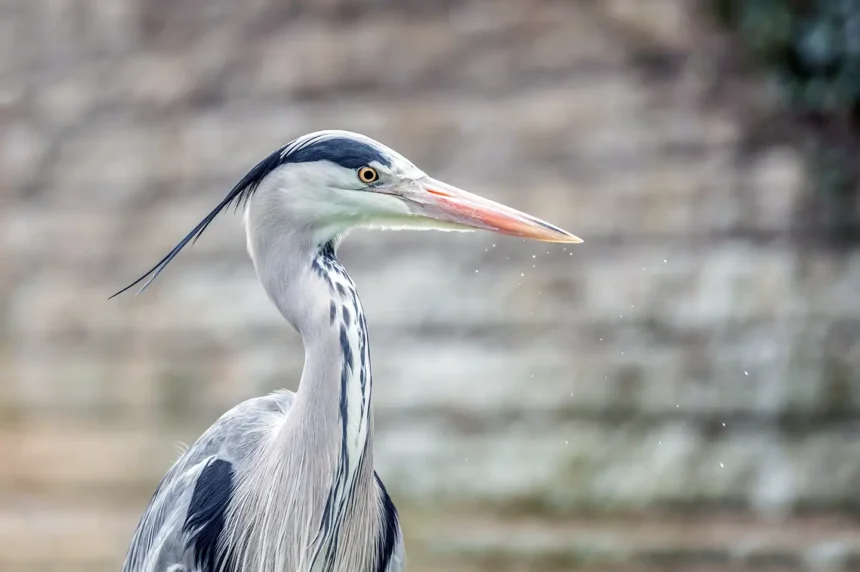
The heron is a representative of water birds, which, despite its rather large body, can easily move in the water on its long, thin legs. An interesting question arises: what is the reason why it is comfortable standing on one limb?
The biologists have several different answers to this question, which is usually asked by young and old zoo visitors.
Rest on one leg
The simplest answer to everyone interested in why a heron stands on one leg is that it is resting. Scientists have decided that this position allows to reduce the load on the legs, and this will significantly reduce their fatigue. This position speeds up the escape from predators. This has been confirmed in practice, as these birds have a habit of sleeping in this position.
However, this assumption was ruled out because the results of the research proved that from this position, the bird needs to make as much effort to move forward as possible, rather than after the usual rest on both limbs.
Heron stand as a way of hunting
The theory of camouflage is no less popular. Fish and frogs mistake a supporting limb for a plant and swim closer, seeing no danger. A bird can hunt equally effectively both in a motionless state in water and by sneaking up on its prey in shallow water.
This posture helps the bird to seize the prey with a sharp lunge forward. Still, according to British ornithologists, the position of the heron’s legs does not affect its hunting. Scientists, supporting the theory of thermoregulation, have come to a single conclusion about the heron’s legs: when one limb is in the water, the other, tucked up, warms itself in the feathers.
Water birds, such as flamingos, storks, and ducks, can be seen standing on one limb. This can probably be explained by the same conclusions as in the case of the heron.
The hypothesis of regulation of body temperature balance
The observations revealed that it was more common to see herons in this position in the water than on the shore. This gave rise to a new idea – the hypothesis of thermoregulation.
According to this hypothesis, the heron is forced to stand on one leg in order to maintain its temperature balance. While in the water, the bird alternately stands on one limb or the other, but always starts with the left one. The heron changes its supporting limb in order not to overcool it, due to the difference between the temperatures of water and air. If the bird were to stand on both legs, or constantly on one leg, it would lose more heat and risk hypothermia and tissue damage. This is clear evidence that the process of thermoregulation is believed to be the main reason for the heron’s position in the water.
The process of thermoregulation is carried out with the help of a special form of vascular branching, which minimises the bird’s heat loss. This plexus of blood vessels creates a so-called heat exchanger, in which the internal temperature of the limbs approaches the ambient temperature.
Other assumptions
Later, scientists came up with another theory that standing on one leg helps a person maintain balance in windy conditions. But then it was also rejected, along with the judgement about the one-legged stance, which allegedly improves blood circulation by reducing the effect of gravity on blood flow.