


“Zhen-zhu” (sea shell) was the name given to a means of payment in ancient China about forty centuries ago in the form of spherical organic mineral formations born in mollusk shells.
Later, “Zhen-zhu” in European languages was called “perle” – so a pearly ball that does not require additional mechanical processing became a piece of jewellery. Before the invention of diamond processing methods (approximately the fifteenth century), pearls were the most expensive stone.
What are pearls and where are they used?
In ancient times, many legends were composed about pearls, most of which endowed them with divine properties.
For example, Queen Cleopatra used pearls not only as jewellery, but also made cosmetic potions from powdered pearls. She also won a bet with Mark Antony for the most expensive dinner by dissolving a large precious pearl in a glass of wine. This dinner is considered the most expensive in human history.
In lithotherapy (stone treatment), pearls are used to treat diseases of the nervous system, gastrointestinal tract, and even as an indicator of cancer: a change in the acid balance in the wearer’s body leads to a clouding of the stone’s surface.
It is believed that due to the naturalness of their origin, natural pearls are able to punish their owner for manifestations of lies, betrayal, treachery and cruelty.
Astrologers attribute this stone to the element of water, and, in terms of energy, consider it compatible with emerald, aquamarine, amethyst, opal, alexandrite and moonstone. At the same time, combinations of pearls with diamond, ruby, coral, garnet, and sapphire are not recommended.
Due to its shape and colour, the pearl is often associated with a tear, so it is considered a female talisman, a symbol of family happiness. It is recommended to wear pearl jewellery for representatives of water signs: Cancer, Scorpio, Pisces. However, the stars advise Leos and Aries to avoid contact with this mineral.
How pearls form
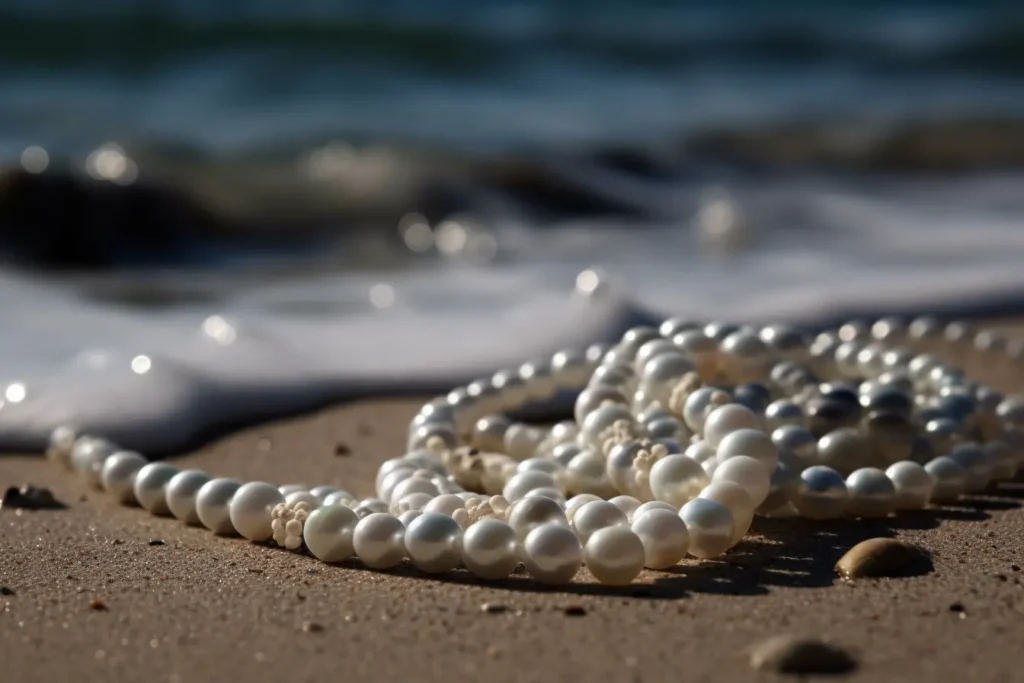
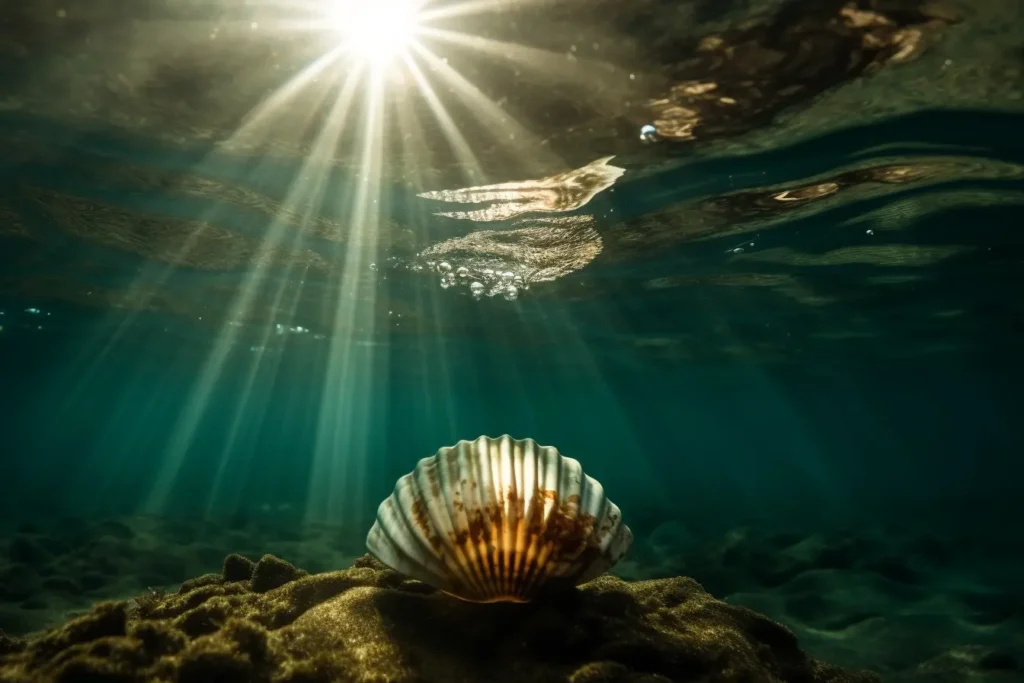
Pearls are the consequences of the mollusk’s defensive reaction to a foreign body. When a foreign object (an air bubble or a grain of sand) gets inside, the so-called “embryo”, the animal, unable to get rid of the irritant, tries to “tame” it by enveloping it in nacre (from the German “Perlmutter” – mother of pearls). Mother-of-pearl is the substance that makes up the inner layer of the shell. It has a multilayered structure formed by calcium carbonate crystals held together by adhesive organic compounds. A ray of light repeatedly reflected and refracted by individual crystals creates the effect of “shimmering” colour from different angles. And the longer the mollusk fights the “invader” in the form of an embryo, the larger the resulting pearl will be. Thus, the “age” of a pearl with a diameter of 10 mm is at least 9 years.
A pearl is not always perfectly round. If the embryo falls not into the soft area of the mantle, but into the muscle or closer to the shell flaps, the shape of the resulting formation will be unpredictable.
If the nacreous layer does not cover the entire surface of the stone due to “growth” to the inside of the shell, it is called “blister”, its value for use in jewellery is lower, and such raw materials often have to be subjected to additional processing.
If the shape of the pearl differs from the spherical one (pear, disc, cylinder), but remains smooth and with an even coating, such pearls are called baroque or baroque. Due to its uniqueness, this type of pearl is valued by manufacturers of exclusive jewellery.
The consumer properties of this organic mineral are evaluated by the following parameters:
- quality – AAA (best quality), AA+, AA, A, B, C;
- hardness – according to the Mohs scale, it ranges from 3.5-4 units (the hardness of a diamond is taken as 10.0);
- diameter – depends on the age, most commonly used sizes are 3.0-20mm;
- color – white (shades: cream, pink and blue), black (shades: brown, golden, blue, purple);
- lustre – silky, matte, iridescent, pearlescent, metallic;
- transparency – transparent (AAA-AA), opaque (A and below);
- weight – the pearl grain is used (50 mg, or 0.25 carat).
At first, pearls were extracted from shells that naturally live in the environment, where a foreign object entered in a natural way. The process was accidental, and sometimes to obtain one pearl, up to 40 shells had to be opened. The increasing demand for pearls extracted from wild shells led to the complete disappearance of some species of mollusks. Currently, natural pearls are among the rarest and most expensive.
Today, 99% of the world market is occupied by cultured pearls. These are natural pearls, the creation and development of which humans have taken under their control. There are two main methods of pearl cultivation: nucleated and non-nucleated.
In the nucleated method, there is a small bead with a diameter of 8-9mm inside the mantle of the mollusk. After 1-2 years, if there was no rejection, the active phase of processing the pearl with nacre begins, and after a year, such a pearl can reach a diameter of 10mm. However, the nacre layer on it is only 0.15-1.2mm thick, which affects the service life of the coating, which on average is 4 years until its destruction.
The non-nucleated method differs from the nucleated one only in the material of the implant – small sand particles are implanted into the oyster’s body, from which pearls are formed over time, which are practically indistinguishable from natural ones.
Types of pearls: freshwater and marine
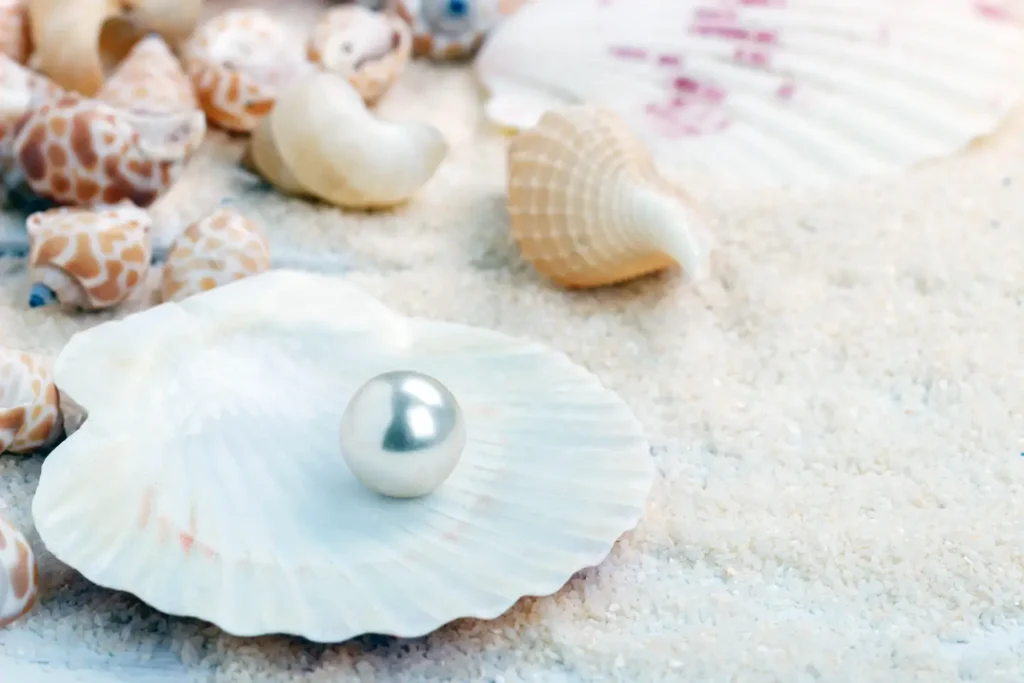
Mollusks capable of forming pearls in their bodies live in both fresh and salt waters, so pearls are divided into freshwater and saltwater pearls.
Freshwater pearls are the cheapest type. This is primarily due to the fact that a river or lake oyster can form up to fifty pearls at a time (sea oysters can form two to five).
Due to the composition of the water and the mollusks’ diet, the lustre of such stones is somewhat “muted” compared to those mined in the sea.
Due to the barbaric methods of extracting such pearls, most freshwater mollusks are on the verge of extinction and are listed in the Red Book. Nowadays, the extraction of freshwater shells on an industrial scale is prohibited, and all river pearls on the market are cultured, using a nuclear-free cultivation method.
The habitat of freshwater pearl oysters is quite wide: from the northern rivers of Europe to the coasts of the Indian and Pacific Oceans. China is the leader in production: pearls grow there even on abandoned rice fields.
The process of growing freshwater pearls is not easy: it is necessary to monitor the composition of the water and the sufficiency of the food supply. To ensure the correct shape of the pearl, the shell must be periodically turned over. After 1.5 years, the stone can reach a diameter of 3 mm, after waiting 3 years, you can get 7 mm, a diameter of more than 10 mm is already a rarity. The colours and shapes are pleasing in their diversity: from white to brown and from egg-shaped to drop or potato. The perfect spherical shape is rare among freshwater pearls.
Sea pearls are more expensive than freshwater pearls. They grow faster and, due to the presence of mineral salts in the water, the degree of lustre and richness of colour in sea pearls is higher than in freshwater pearls. However, the hardness of a sea gem is lower than that of a river gem.
Another factor that affects the price is that the cultivation of sea pearls is associated with a great risk for the farmer. Shells are found in the natural marine environment, where weather conditions are not always favourable. A storm or a change in water temperature of just one or two degrees can “nullify” the results of many years of work (the average life expectancy of a sea oyster that forms pearls is 8-10 years).
The most popular in the world are Akoya pearls, South Sea pearls, and Tahitian pearls.
Akoya pearls are a type of cultured pearls grown in the waters of the Sea of Japan. It is valued for its perfectly rounded shape and for its white or grey-blue colour with a characteristic iridescence, which is the standard for this species. Recently, China has been actively trying to join the export of Akoya.
Elite South Sea pearls are rare and expensive. White and gold pearls are supplied to the market by Australia and Indonesia. The unique nature of Australia has given rise to shells that reach up to 300mm in diameter. Such oysters are more difficult to grow, the harvest is smaller compared to Japanese oysters, but the pearls themselves are 6-20mm in diameter. In addition, the structure of the nacreous shell of Australian pearls is denser.
Tahitian pearls are also called black pearls. Large black-lipped oysters, which live only in the seas of Polynesia, are capable of producing natural pearls of all shades of black. The tint can be aubergine, blue, olive and even dark red. The most expensive colours are cobalt and blue-green. It can take many years to select stones for a “matching” necklace. The prices for such products are amazing.
History of pearl mining
Pearl mining has been a state monopoly since the 16th century. During the colonial era, the Portuguese controlled the fishing of pearl shells in the Gulf of Mannar in the Indian Ocean, and then, after the conquest of the colonies, this right was transferred to the Dutch. Later, for three centuries, the British crown managed the pearl fields. Today, India is the monopolist in the extraction of natural pearls in these waters.
Initially, the owners of the pearl “mines” set strict mining rules: it was possible to dive for pearls only one month a year and at certain times of the day. There was no shortage of hunters for quick cash, but only a few were successful. Yes, an experienced diver could identify a shell with a pearl by subtle changes in its shape, but most did not bother with such trifles – the whole colony came to the surface and the shells were sold by the barrel.
With the growing demand for pearls, the conditions and methods of their extraction have changed: in the coastal waters of Sri Lanka, oysters were extracted year-round using dredging machines, which resulted in the complete destruction of the mollusc population.
The situation was saved by the technology of artificial pearl cultivation. It has been known in ancient China since the 13th century: an embryo was placed under the mantle of a mollusk and after 3-4 years, a finished pearl was extracted from the shell. Such stones were not popular until the beginning of the XX century – due to the thin layer of mother-of-pearl, they could not boast of a wealth of colours and shades. In addition, the bottom, where the embryo came into contact with the sink flap, was black, loose and unripe.
In 1888, a poor Japanese merchant, Kokichi Mikimoto, bought a loss-making oyster farm for restaurants. He decides to start breeding oysters that form pearls, improving on the imperfect Chinese cultivation technology. The idea was to grow a pearl in two steps: first, a foreign body was planted in the body of the mollusk, as before, and then, when it was completely covered by the mantle, it was removed again and put inside another shell in this form.
The new technology made a breakthrough in the process of growing cultured pearls – the number of embryo rejections decreased significantly, and the pearls themselves turned out to be of much higher quality and almost indistinguishable from those obtained naturally.
Mikimoto became one of the top ten inventors in the country, and Japan became the largest exporter of high-quality pearls for a long time. Later, he was the first to use baskets for breeding and keeping oysters – the damage caused by tides and sudden temperature changes, which previously led to massive population loss, was now negated. Residents of the island of Tatokujima, which became famous for its affordable and high-quality pearls, erected a monument to the inventor.
But the profession of pearl hunters has not disappeared completely. Even today, divers in the coastal waters of China and Ceylon, in the Gulf of Mexico and the Caribbean, and, of course, off the coast of Tahiti continue to pull rare nuggets born by tireless oyster workers to the surface. Due to the high value of these natural pearls, they are not used for jewellery making, but rather serve as objects of collections and long-term investments.
5 differences between real and fake pearls
In order to meet the massive demand for pearl jewellery, the production of artificial synthetic gems has been put into production. A gelatinous mass with the addition of pearl essence (a paste obtained from fish scales) is used to make a copy. Such a ball is painted with dissolved mother-of-pearl, which, after hardening, really resembles a real pearl.
Glass and plastic spheres treated with formaldehyde and mineral salts for strength are also used. Covered with a layer of pearl essence and painted with pearlescent paint, such artificial “pearls” are used in the manufacture of cheap jewellery.
Natural stone is distinguished by 5 features that are quite difficult to fake:
- A naturally grown pearl is always heavier than an artificial one;
- a fake is immediately recognised by its lifeless, uneven surface lustre;
- a stone formed by a mollusk will bounce back elastically after falling from a small height onto a hard surface due to its multi-layered structure, while an imitation does not have such properties;
- an artificial pearl placed in acetone will begin to dissolve;
- a natural stone will remain cool when held in the hand, which is not the case with a fake.
And, of course, a professional jeweller will help to completely dispel doubts about the authenticity of the pearl with the help of special devices, tools and techniques.