


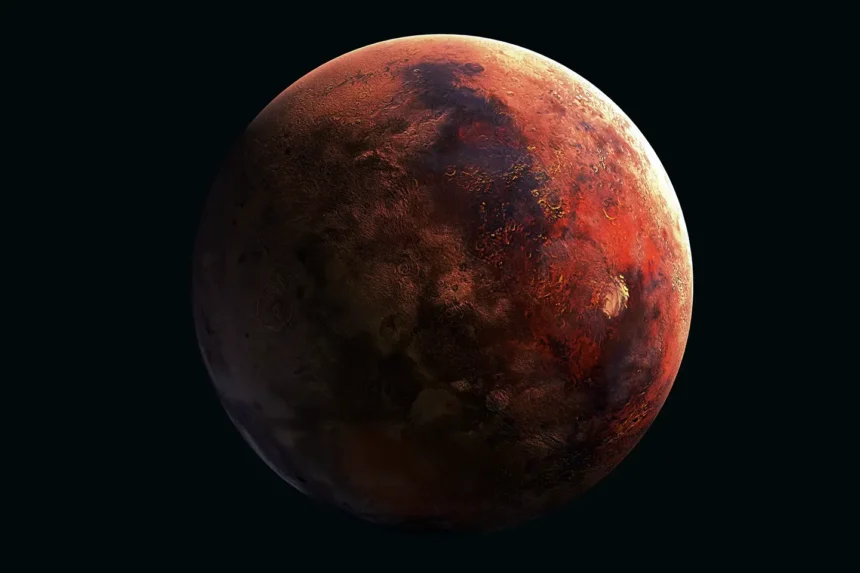
Mars is a small planet that has found its place in the Solar System between the Earth and Jupiter. In terms of distance from the Sun (228 million km), it is the fourth planet. In terms of its structure, Mars is more similar to our planet.
Features of the planet Mars
Since the invention of the telescope by Galileo Galilei, there has been a thorough study of the planet, with Mars being the most explored among other planets in the Solar System due to the absence of a cloudy layer. When our planet is located between the Sun and Mars, the minimum distance from Mars to Earth is 55.76 million km, while the maximum distance is 401 million km when the Sun is located between Earth and Mars.
The average temperature of the planet is -66°C, with temperature fluctuations ranging from -153°C to +20°C.
Mars has an atmospheric layer with a minimal oxygen content of 0.13%.
The existence of any simple form of life on the planet’s surface is unlikely due to the too sparse atmosphere and weak magnetic field, which allows solar radiation to almost unhinderedly reach the surface of Mars.
The planet has an elliptical orbit, which explains seasonal irregularities: in the northern part, the spring and summer periods last longer than the autumn and winter, while in the southern part, the opposite is true.
How did Mars get the name “Red Planet”?
It’s easy to recognize Mars due to its red color. The planet was named after the Roman god of war, Mars, who rode a chariot pulled by the twin gods of terror and fear, named Deimos and Phobos, respectively. Two of Mars’ natural satellites were named after them.
Thanks to modern research, it has been discovered that the planet’s surface appears red under certain solar conditions. The red color is explained by the presence of iron oxide or rust on the surface. Iron reacts with water in the presence of oxygen, creating a film of red-orange iron oxide. It is likely that the rust formed long ago when there was a lot of water on the planet’s surface, and it spread through dust storms.
What color is Mars actually?
As mentioned above, Mars appears red under certain solar conditions. In fact, its colour is made up of different colours: brown, golden and greenish. In addition to iron, the planet is rich in other minerals: magnesium, calcium, aluminium and potassium. Thanks to this, the surface of the planet can change its colour from bright orange to brown and even black. Unlike on Earth, where the sunset is orange, on Mars it is almost blue.
Interesting facts about Mars
“The Red Planet” has already been studied enough, but not completely.
TOP 10 interesting facts about Mars:
- The planet’s mass is nearly ten times smaller than Earth’s.
- The surface area of Mars barely reaches 28% of Earth’s surface area.
- A year on the “Red Planet” lasts for 687 Earth days.
- The length of a day is 1477 minutes.
- The planet has a diameter of 6792 km.
- “Olympus” – the highest mountain (22,456 m) in the Solar System is located on Mars.
- In 1888, Italian astronomer Giovanni Schiaparelli created the first detailed map depicting the seas and the so-called Martian canals.
- The period of dust storms lasts for months and covers the entire surface of the “Red Planet.”
- The massive system of canyons in the Mariner Valley on the “Red Planet” was discovered in 1971-72. Its length is 4,000 km, width – 200 km, maximum depth – 6 km.
- NASA and the European Space Agency plan to land a human on Mars by 2035.