


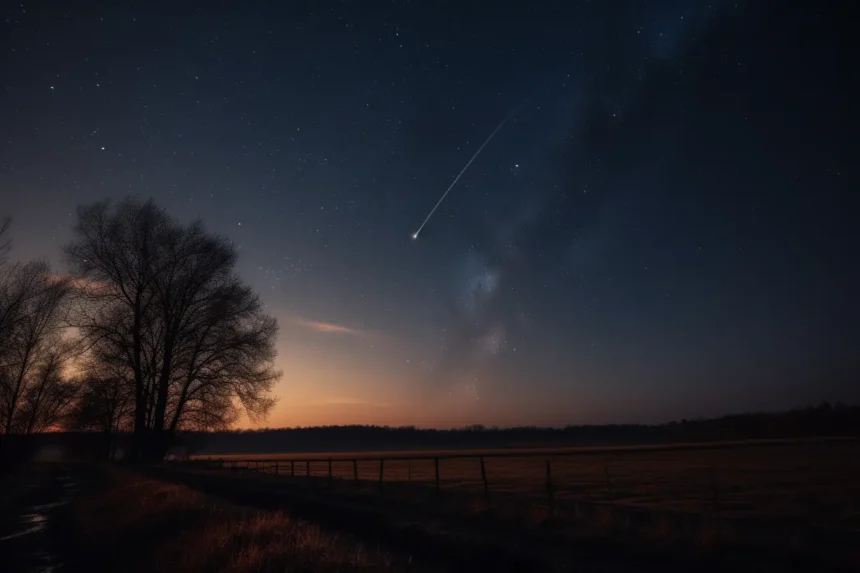
Looking up at the sky at night, you can see many stars, the moon, some constellations, the Milky Way, and sometimes you can even see a shooting star. Or is it not really a star?
The diversity of cosmic bodies in outer space
There are many cosmic bodies in space that differ significantly in size. Some are as small as a few microns, while others are hundreds of kilometres in diameter. Sometimes some of them reach our planet and we call them meteors, meteorites or meteoroids. What is the difference between them, and is there any?
Difference between similar space terms
The following names are often used in scientific space terminology:
- asteroid
- meteoroid
- meteor;
- meteorite.
An asteroid is a solid celestial body with a diameter ranging from one to a thousand kilometres. It belongs to the small bodies of the Solar System and moves in orbit.
Meteoroids are mini asteroids. The largest of them barely reach 30 metres in diameter.
Due to their enormous speed (tens of kilometres per second), meteoroids heat up when they enter the atmosphere so that a bright streak of light remains after them for a short time.
This fascinating phenomenon is as familiar to us as a meteor.
Many meteoroids that come across the Earth’s path cause meteor showers. Small meteoroids usually burn up completely, while larger ones leave behind pieces that fall to Earth.
A meteorite is a space body that has already fallen to the Earth’s surface. It looks like a piece of burnt stone or molten metal.
If numerous meteorites fall out of the atmosphere as a result of a meteoroid or asteroid breaking up, it is called a meteor shower.
Frequency of meteorite impacts
Scientists have conducted scientific research on meteorites that have fallen to the Earth’s surface over the past hundred years. They created a histogram of the distribution of impacts by year and determined the frequency of meteorites falling to Earth depending on their initial diameter. For meteorites such as the Chelyabinsk meteorite, the average interval between impacts is approximately 30-40 years.
In general, more than 5-6,000 meteorites or more than 2,000 tonnes of meteorites reach our planet per day or annually.
In addition to meteorites, meteorite dust flies to the Earth’s surface, the amount of which varies daily from 300 tonnes to 20,000 tonnes.
Why meteors and meteorites are dangerous
Small particles contained in a meteorite body can damage the surface of spacecraft and disable their power systems.
After a large meteorite falls, the earth’s axis may shift, which can negatively affect climatic conditions.
Let’s look at the scale of the problem using the example of the Tunguska meteorite. It occurred on 30 June 1908 in the basin of the Tunguska River. Fortunately, it fell on an uninhabited taiga territory, damaging an area of several thousand square kilometres. If it had been a large city, it could have been a real disaster.