




Population is the sum total of all people living on the Earth. According to estimates by Peter Grunwald, a statistician at the Dutch Centre for Mathematics and Informatics, who conducted his calculations at the request of the monthly Quest magazine, approximately 107 billion people have been born on our planet throughout human history.
The world’s population
As of June 2022, the world’s population is estimated at 7.95 billion people. The total area of the Earth’s surface is 136,120,354 km². This means that the world’s population density is 58.4 people per square kilometre.
The urban population (54%) is larger than the rural population (46%), and the number of urban dwellers is growing faster.
The male population (50.5%) exceeds the female population (49.5%).
The Japanese have the highest average life expectancy of any country in the world. It is 48.6 years. In 2020, 29.18% of the Japanese population was over 65 years old.
10 countries with the largest population
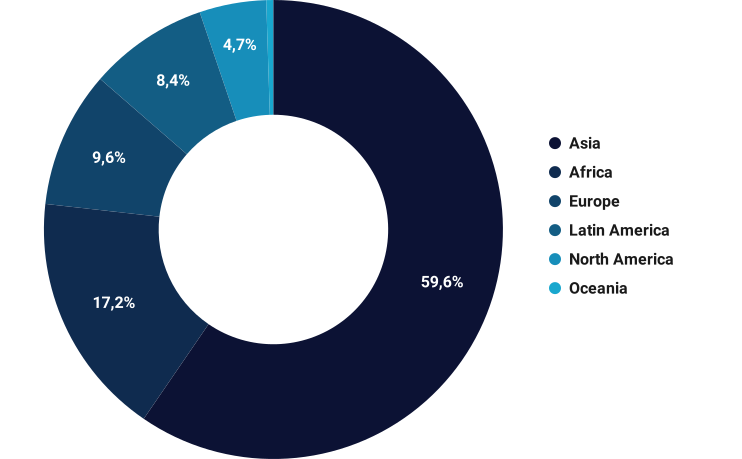
Based on observations made in 2020, it was determined that:
- 59.5% live in Asia;
- in Africa – 17.2%;
- in Europe – 9.6%;
- Latin America – 8.4%;
- North America – 4.7%;
- Oceania – 0.5%.
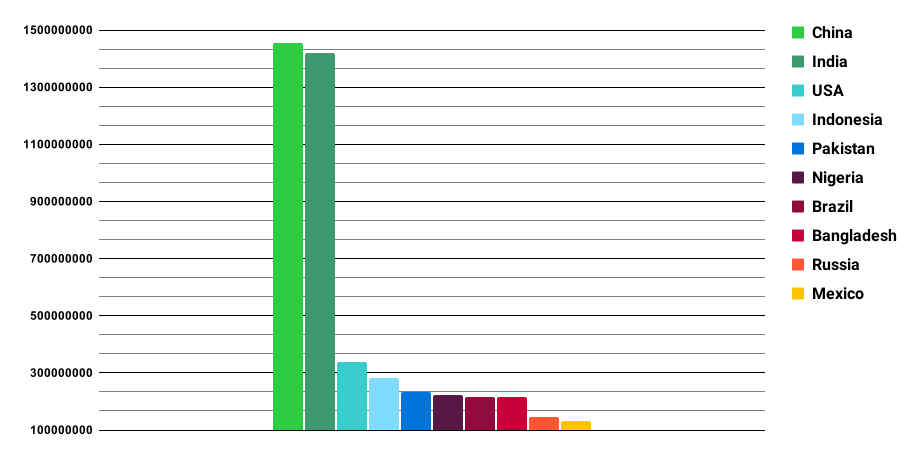
TOP-10 countries with the largest population:
- China – 1 455 070 344;
- India – 1 419 070 628;
- USA – 336 531 540;
- Indonesia – 281 868 607;
- Pakistan – 233 572 422;
- Nigeria – 221 473 189;
- Brazil – 216 877 936;
- Bangladesh – 216 877 936;
- Russia – 146 110 114;
- Mexico – 132 840 394.
Which country has the most people
China ranks first in terms of population. Its population is 1,411,778,724 people. The annual growth of the Chinese population from 2010 to 2020 decreased by 0.05% compared to the period from 2000 to 2010. In 2016, 18 million children were born, and in 2020, only 12 million. According to the census, there are 880 million people aged 16 to 59, compared to 920 million in 2010. According to statistics, 18% of the total population of China are children under the age of fourteen. An indicator of the development of a country’s economy is the dynamics of population growth, i.e. in countries with highly developed economies, the birth rate is usually declining and the population is shrinking. In the seventies of the twentieth century, China launched a social experiment that prohibited families from having more than one child. The purpose of this experiment was to reduce the number of Chinese people. Two years after the cancellation of this experiment, which happened in 2016, the population began to grow.
According to forecasts:
- the number of Chinese will peak in 2029 and then begin to decline;
- India will overtake China in terms of population by 2027;
- from 2019 to 2050, the Chinese population will decrease by 31.1 million people.
Which country has the fewest people
TOP-10 countries with the smallest population:
- Maldives. Area – 298 km², population – 396 thousand.
- Seychelles. Area – 455 km², population – 84 thousand people.
- Marshall Islands. Area – 181 km², population – 62 thousand.
- Saint Kitts and Nevis. Area – 261 km², population – 53 192.
- Liechtenstein. Area – 160.4 km², population – 38 137.
- San Marino. Area – 61 km², population – 33 938
- Monaco. Area – 2.02 km², population – 30 thousand inhabitants.
- Tuvalu. Area – 26 km², population – 10.5 thousand people.
- Nauru. Area – 21.3 km², population – about 9 thousand people.
- Vatican City: 44 hectares, population approximately 800 people.
The Vatican is located in one of the districts of Rome. This closed city-state was founded in 1929. It is governed by the Pope. The Vatican is famous for its extraordinary architectural creations, such as:
- The Sistine Chapel;
- Apostolic Palace;
- St Peter’s Cathedral;
- Mater Ecclesiae Monastery;
- Raphael’s loggias.
The Vatican gardens stretch over almost half of the territory.
Despite the small number of citizens, several thousand Italians come to the Vatican to work every day.
Factors affecting population growth
According to the UN forecast, the population will grow by two billion by 2050, reaching almost 11 billion by the end of the century.
The following factors have a positive impact on population growth:
- The birth rate.
- Increase in life expectancy.
- International migration.